
Williamsburg County, South Carolina
Grace & George Dorsey
The ones who bought back the ground, 1892 to today
About This Chapter
In the last chapter, a marriage settlement scattered Elvira and her children, and family, war, and time slowly gathered them back together. By January 1892, Elvira's daughter Grace and her husband George Dorsey stood in front of a Williamsburg County records office and signed for seventy-seven acres of the very land their family had once been forced to work without pay or freedom.
This is not a metaphor. It is a deed. And it is the beginning of everything that follows: a school, a church, a family's right to vote, and more than a century of a Black family holding onto land in a county built to make sure they never could.
This chapter follows Grace and George from that 1892 signature to Grace's death in 1944, and forward again to a direct descendant, five generations later, who decided their story was American history and started writing it down.
Chapter Contents
You may navigate this chapter via the index below.
I. Seventy-Seven Acres
January 1892, Nesmith, Williamsburg County
The land Grace and George Dorsey bought in January 1892 was not a fresh start on neutral ground. It was the same plantation where Grace had been enslaved as a child, and where George had been enslaved alongside her. The seller was J. Zuill McConnell, son of John Thomas and Mary Brisbane Hext-McConnell, the couple who had once held them both.
The name Grace and George gave their new land was not subtle. They called it Dorsey Town.
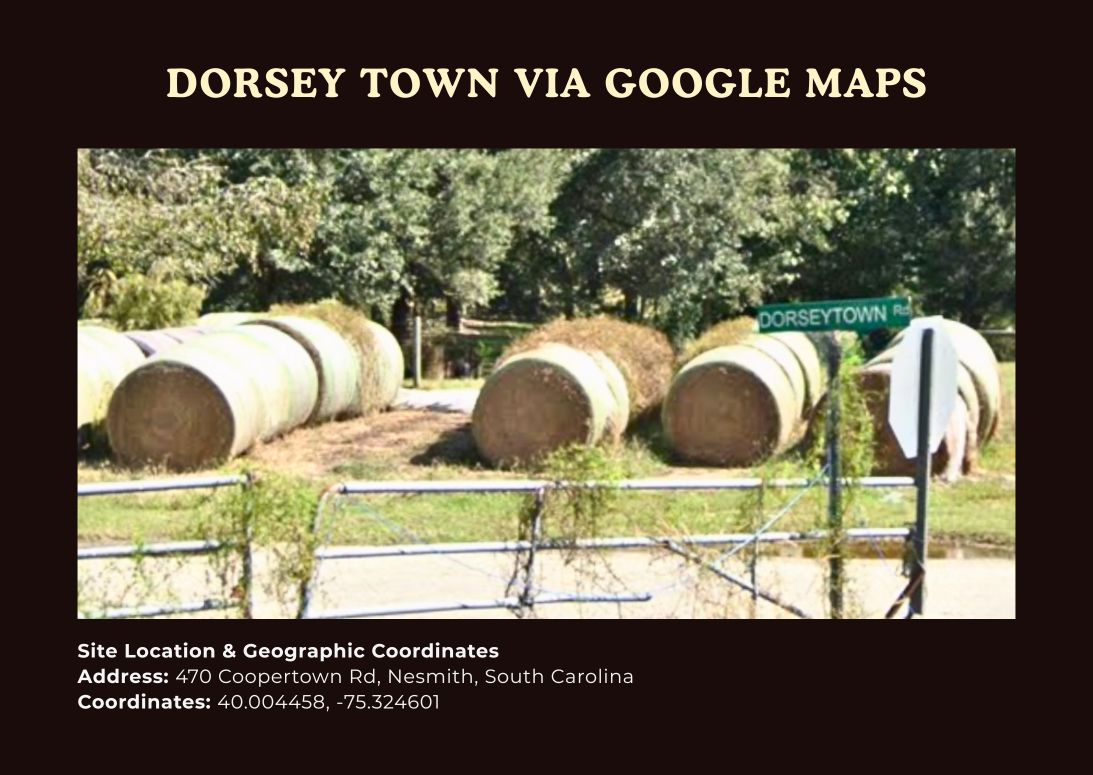
"In a remarkable twist of fate, George and Grace purchased the very plantation John Thomas and Mary Brisbane Hext-McConnell had enslaved them on. This purchase was more than just an acquisition, it was a reclamation of dignity and a tangible legacy for their family."
Tanya Jones
Research Note
Family research places the purchase on a specific date, January 21, 1892, for $165, paid off within two months. The original deed itself has not yet surfaced, and may never have existed as formal paper, see the note above. What does survive, and stands as the strongest land-ownership proof in this archive, is a 1934 court record tied to the next generation's purchase. See Section IV.
II. What They Built: A School and a Church
On their own land, George and Grace opened Dorsey Town School, a one-room schoolhouse for their children and their community, in a county where teaching Black children had been illegal within living memory.
There is a quiet symmetry to it: Mary Brisbane Hext had come to Nesmith in 1855 as a schoolteacher, in service of the McConnell family's own children. Four decades later, the family she had once enslaved reopened a school on that same ground, this time for their own.
On January 20, 1892, the day before the land purchase, George Dorsey was among the founding members of Mt. Ararat AME Church. Trustees S.D. McBryde, Toney Scott, and Sam Davis received the land on the church's behalf.
One acre, on the Sand Ridge Road between Rhems and Morrisville, was donated for one dollar by D.D. Rhem, F. Rhem, and Mrs. L.A. Rhem, doing business together as F. Rhem & Sons, on one condition, recorded directly in the surviving deed:
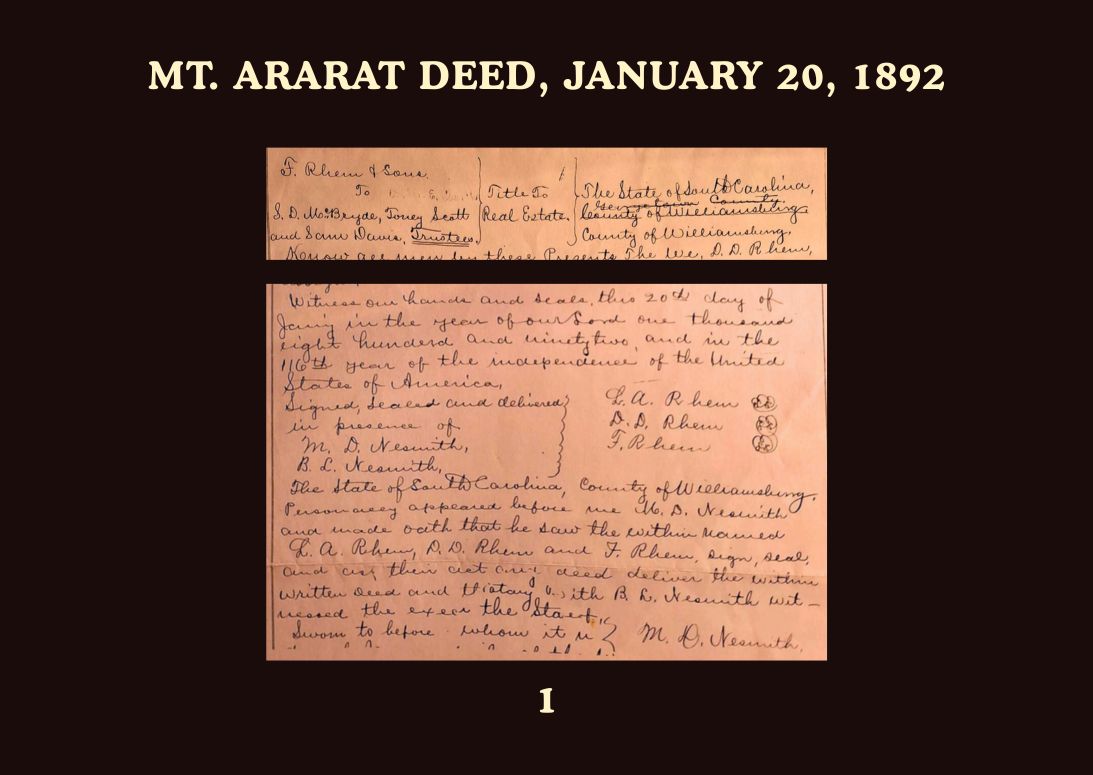
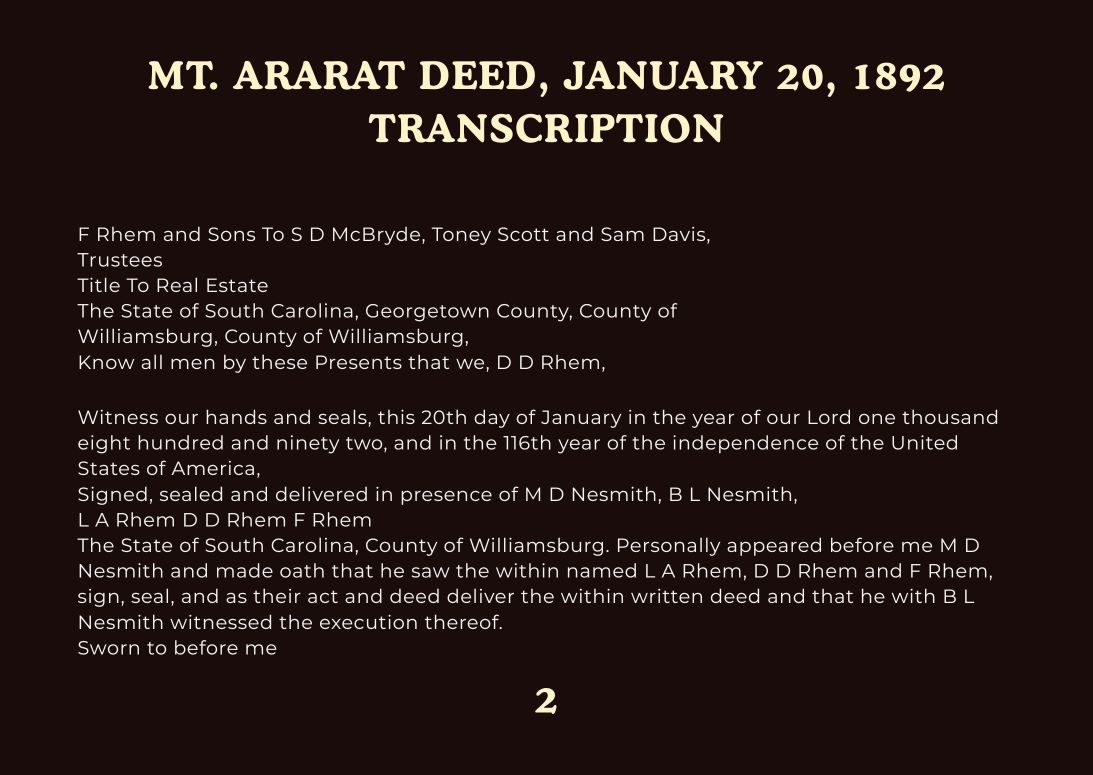
"Provided nevertheless, that the said one acre of land shall continue to be used as a place of meeting for worship... [or] the said land shall revert to, and again become, the property of us, the said F. Rhem & Sons, or our assigns."
Deed, F. Rhem & Sons to Mt. Ararat AME Church trustees, January 20, 1892
Mt. Ararat Church was destroyed by fire twice and has since been relocated, but the family cemetery connected to it is still in use today.
III. The Vote
May 20, 1882, Black Mingo Precinct, Williamsburg County
George Dorsey exercised his right to vote on May 20, 1882, at the Black Mingo Precinct, according to the Williamsburg County South Carolina Voter Registration Book of 1882–1892.
Family history also holds that an elder in the family, "Uncle" Smart Snow, registered to vote in 1868 at the Carver's Bay Precinct at age twenty-five, among the earliest in the family to exercise the right guaranteed by the Fifteenth Amendment.
Between 1866 and 1876, more than 6,000 formerly enslaved Black men in Williamsburg County registered to vote. George Dorsey's name in that registration book places him inside that number, not as a statistic, but as a specific, documented man exercising a specific, documented right.
IV. Expanding the Ground
1917, Williamsburg County
In 1917, Grace and George's sons Mosey (Moses) and Peterson, together with Rosena's son Stephen White and Charley Chandler, purchased 400 additional acres, land tied to the inheritance of Eliza Ann McConnell, the same baby girl Grace had once nursed inside the McConnell house.
Some years later, a relative on the McGee side of the family, Rhina, Grace's own sister, had married a McGee, died without a will. Rather than risk the family's claim to the land being lost or divided informally, Mosey took the matter to court. He won. The court split the land into four equal 100-acre parcels, plus ten acres on the Black River, appraised and divided the same careful, on-paper way Jane McConnell's own will had once divided Oak Hall among her children, so that no one could dispute it later.
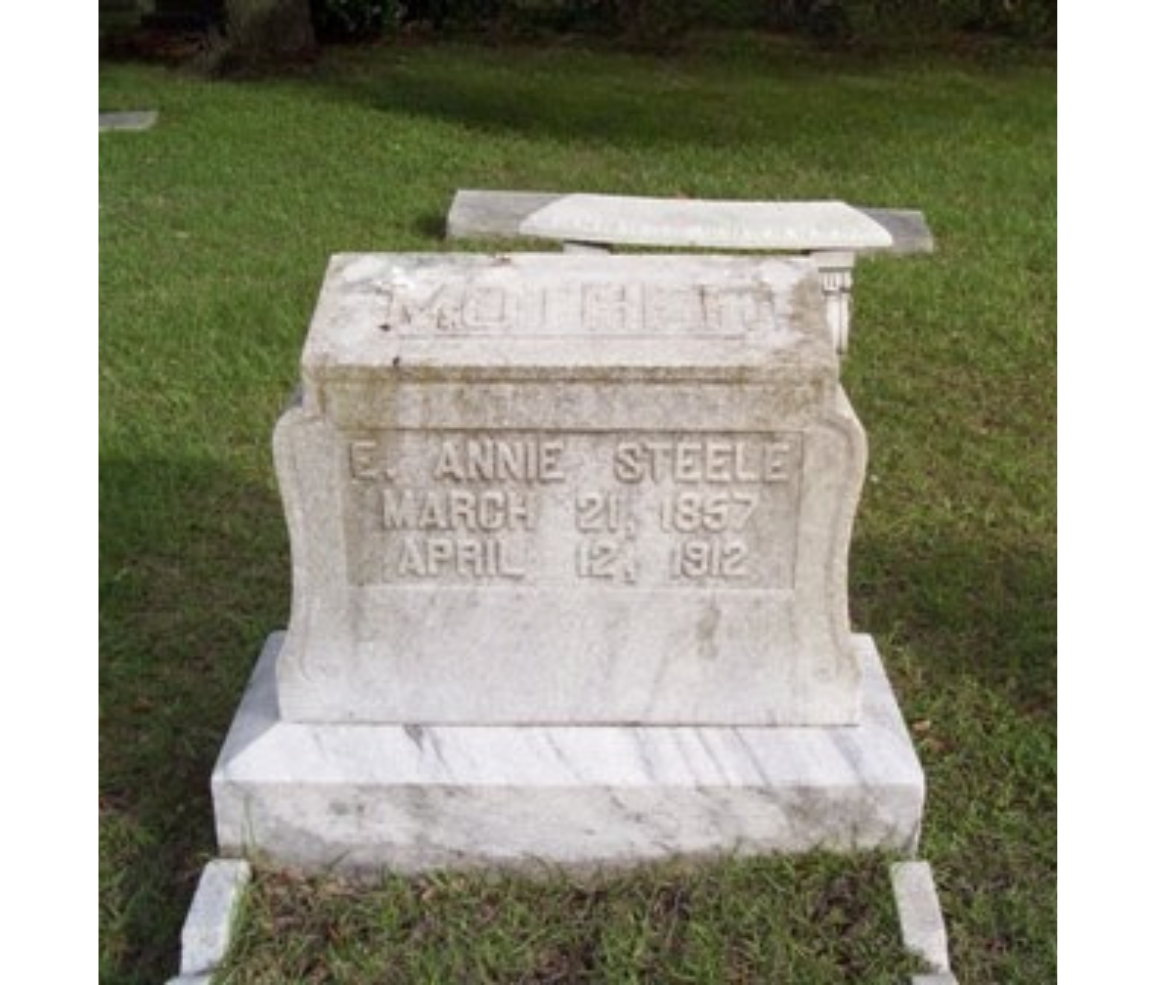
Headstone of Eliza Ann McConnell (later E. Annie Steele), 1857–1912 — the baby Grace nursed, whose inherited land is the 400 acres discussed above.
Research Note
This court case is the strongest piece of land-ownership evidence in this entire archive, stronger, in some ways, than the missing 1892 deed, because a court ruling is a public record by its nature. Family history is consistent on what happened and how the land was divided, but the exact year of the ruling is not yet confirmed in this archive. Once the original court record is located, the date should be added here directly.
Cross-Reference
The same careful, appraised, no-one-can-dispute-it approach shows up twice in this family's history, once when Jane McConnell divided Oak Hall among her six children in her 1864 will, and again when Mosey divided this land among the family decades later. Worth a line linking back to Jane's chapter, since it's the same method used on both sides of this land's story.
V. Two Deaths, One Ground
1918 and 1944, Millpond Cemetery, Williamsburg County
George Dorsey died in 1918. He was buried at Millpond Cemetery, also called Jack's Creek Millpond Graveyard, on the edge of the Black Mingo River, the same burial ground already documented elsewhere on this site as the resting place of the enslaved community from Oak Hall.
"Here is one who is sleeping in faith and love. An honest old servant he has been trusted with many things and was always found honest. His memory shall ever be a guiding star in Heaven."
Headstone, George Dorsey, Millpond Cemetery
Grace Dorsey died on January 23, 1944. Her death certificate, Williamsburg County, South Carolina, Certificate of Death #01393, records her age as 110 and her cause of death as influenza. She was buried beside George, at the same cemetery, within sight of the plantation where she had once been enslaved as a child.
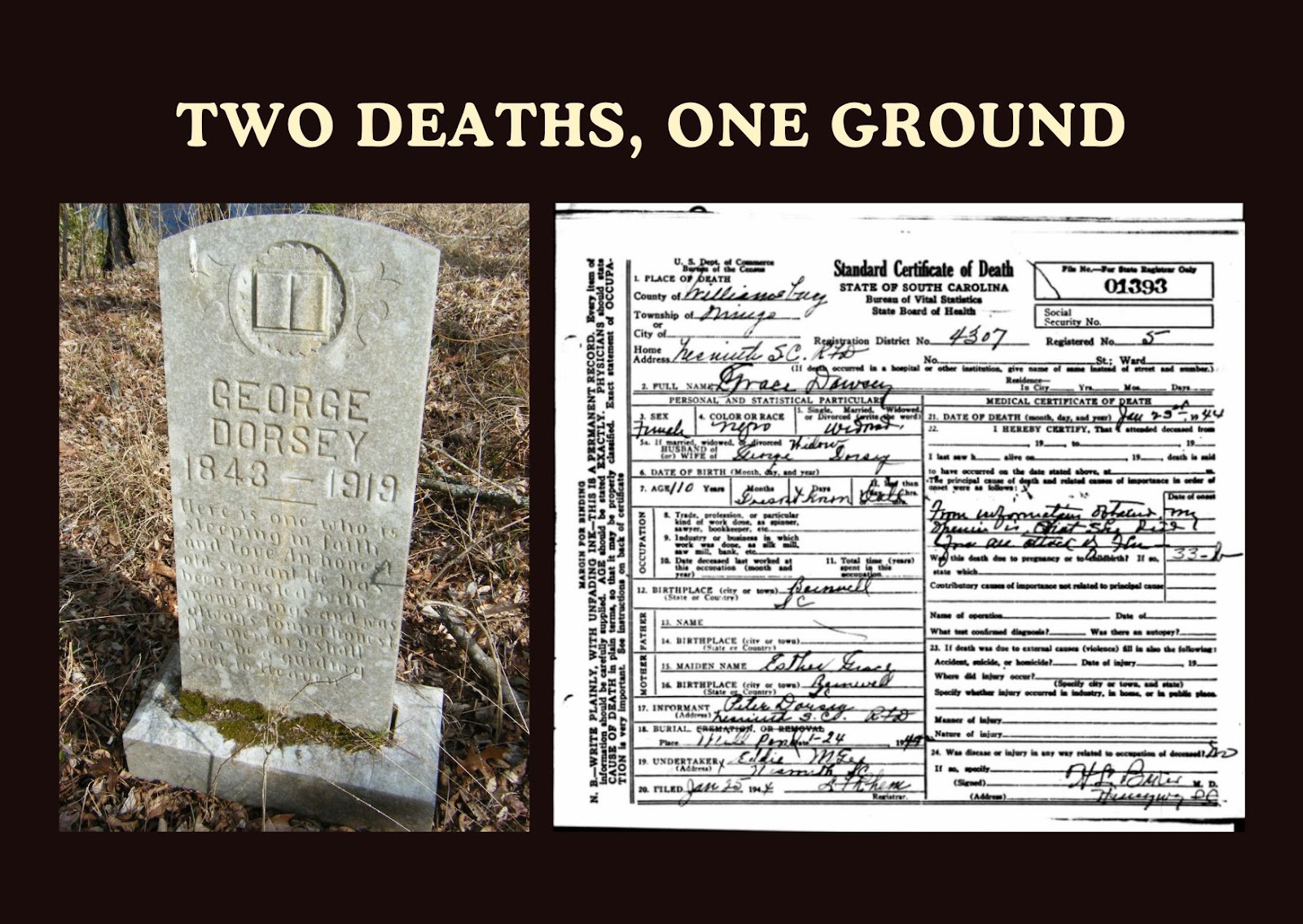
Left: George Dorsey's headstone, Millpond Cemetery. Right: Grace Dorsey's Certificate of Death, #01393.
Cross-Reference
This is the same cemetery documented on this site's "The Ground That Remembered Them" page. That page should link forward to this one, and this section should link back, together they're the same ground, seen from two angles, the anonymous dead, and two people whose names and dates survive in full.
VI. The Family That Still Owns It
1892 to Present, Dorsey Town, Williamsburg County
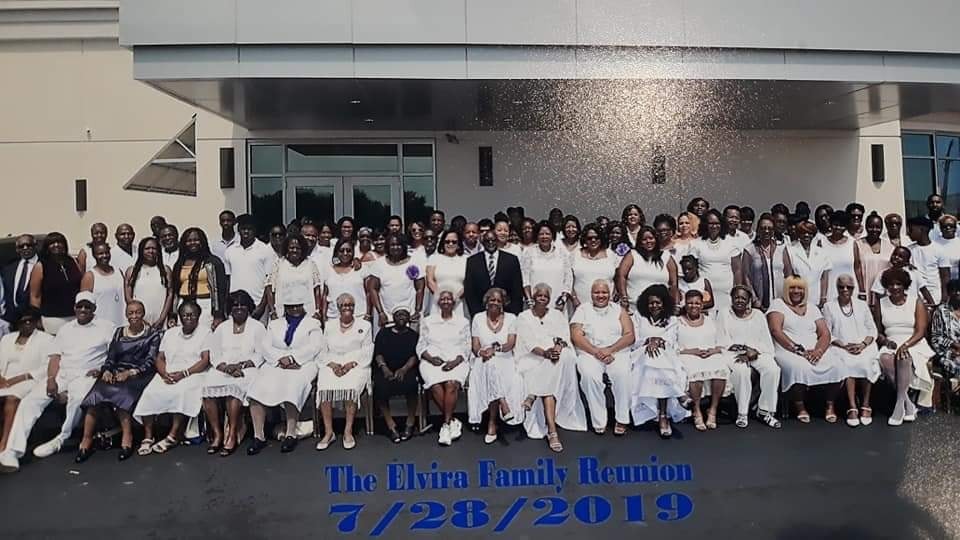
Descendants of Grace and George still live on and hold land connected to Dorsey Town today. Every two years, the family gathers for the Elvira Family Reunion, named for Grace's mother, drawing between 800 and 1,000 descendants as of the most recent count. Land ownership traces in an unbroken line from the 1892 purchase to the present.
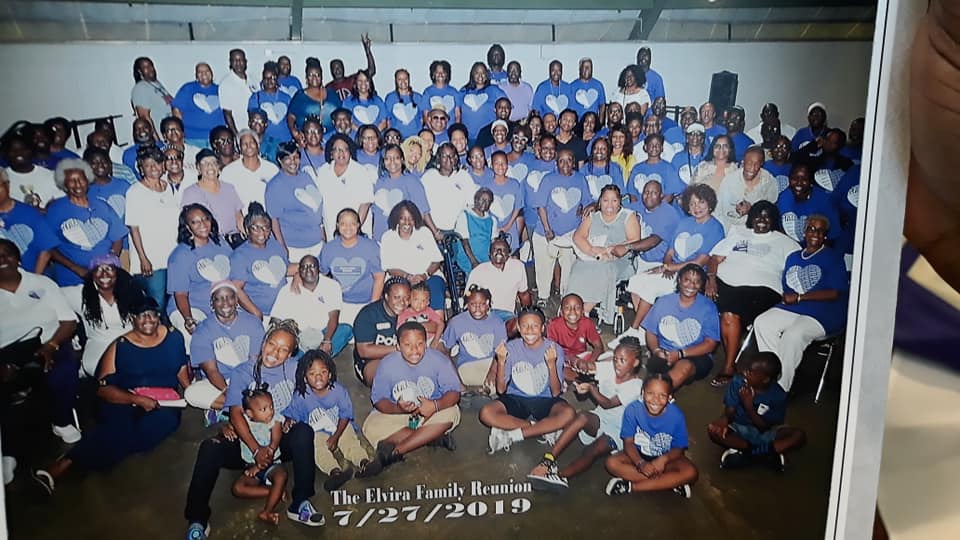
The Elvira Family Reunion, in earlier years.
The Elvira Family Reunion, most recently.
VII. Told By Her Descendant
January 2016, Columbia, South Carolina
Grace Dorsey spent 110 years alive and left no written memoir. What survives of her voice survives because her family kept telling her story out loud, at kitchen tables and reunion tents, long after the courthouse records went quiet.
Tanya R. Jones is Grace's fourth-great-granddaughter. In January 2016, the University of South Carolina in Columbia contacted her to say they had received roughly 1,500 letters, written between the 1840s and the 1870s, preserved by a descendant of Julia Hext Best, sister to Mary Brisbane Hext-McConnell. Those letters confirmed and deepened years of research Tanya had already been doing into her own family's path from Barnwell to Nesmith.
"The saga of slavery, family separation and freedom is extraordinary to document, but the human redemption from the struggles of history transcend to positive attributes within our family legacy."
Tanya Jones, citing Frederick Douglass
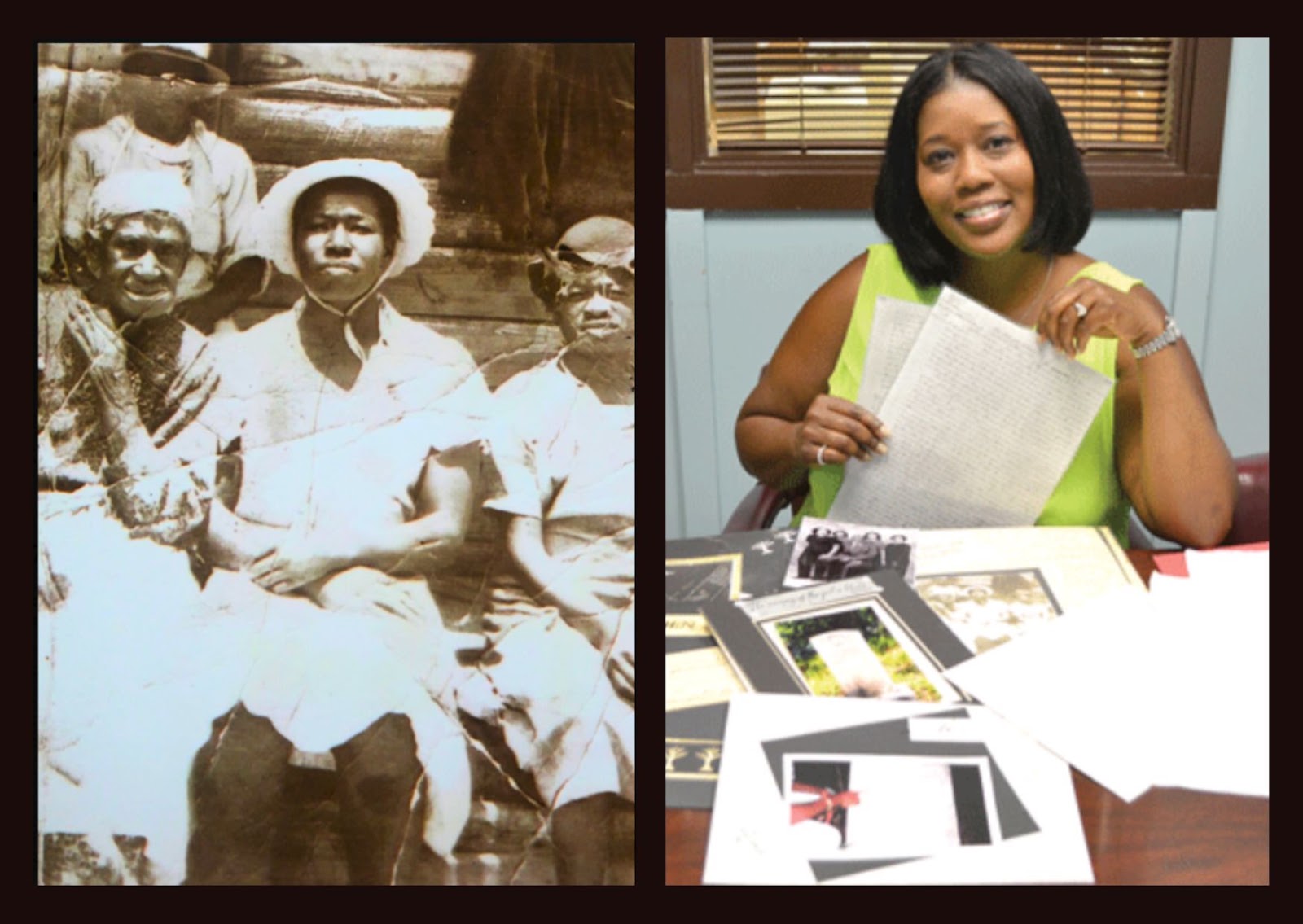
Left: Grace Dorsey and Elizabeth Dorsey, wife of Grace's seventh son, Peterson Dorsey. Right: Tanya R. Jones, Grace's fourth-great-granddaughter, with the family's letters and archive, 170 years after Grace first arrived at Oak Hall.
This chapter closes the story this project set out to tell, a mother, torn from her children as part of a wedding gift, a daughter who came home, married, and bought back the very ground she had once been forced to work, and, one hundred and seventy years after Grace first arrived at Oak Hall, a descendant who read the deed, the will, the letters, and the headstones, and decided the silence had gone on long enough.
Glossary
Dorsey Town
The community Grace and George Dorsey founded on the land they purchased in 1892, on the same ground where they had once been enslaved.
Reclamation
The act of reclaiming something once taken. Used here to describe the land purchase as more than a real estate transaction, a reversal of the plantation's original claim on Grace and George's lives.
Voter Registration Book
An official county record listing eligible voters by name, precinct, and date of registration. George Dorsey's entry in the 1882–1892 Williamsburg County book documents his exercise of the right guaranteed by the Fifteenth Amendment.
Certificate of Death
An official state record of a person's death, including date, age, and cause. Grace Dorsey's certificate (#01393) is the primary source for the date and circumstances of her death in 1944.