

Williamsburg County, South Carolina
Cleland Belin
The Man Who Built a Church in Willtown
The Man Who Built the Church With Their Hands
Cleland Belin was a merchant, a slaveholder, and a churchbuilder. He moved goods and wielded power across Williamsburg County with precision. But the full story of who he was and what he built is written not just in ledgers, but in architecture, in legal documents, and in stone.
This chapter follows Belin from the trading waters of Black Mingo Creek to the church he raised with enslaved hands and the will that made his intentions permanent.
Chapter Contents
You may navigate this chapter via the index below.
I. Setting the Scene
Where two roads meet the water, a dot on a map becomes the center of the world. Belin did not stumble into Willtown. He chose it.
II. Who He Was
A merchant who moved tobacco, cotton, and produce across Williamsburg County. A father who buried eleven of his thirteen children. A man described as pious and melancholy, in that order.
III. The Church He Built and The Slave Gallery
In 1843, Belin built a church with enslaved hands, then directed those same people upstairs. The balcony was not an afterthought. It was the point.
IV. What His Will Said
He died in 1868 but not before putting his beliefs into a legal document. Black members built the church. His will made sure they could never run it.
V. What the Cemetery Tells Us
The church is gone. The cemetery remains. And behind a fence, separated even in death, is a man named Bill, whose labor built everything Belin claimed as his own.
VI. Glossary
Key terms and definitions to help place this chapter in its full historical context.
Setting the Scene
Look at the 1825 Mills' Atlas of South Carolina. Right there, where two roads cross the water, it reads Willtown or Bl. Mingo P.O. That dot on the map wasn't just a post office. It was the center of the world for everyone who lived along Black Mingo Creek.

Mills' Atlas of South Carolina, 1825 the dot where Black Mingo Creek meets the Post Road is where Belin built his empire.
Who He Was
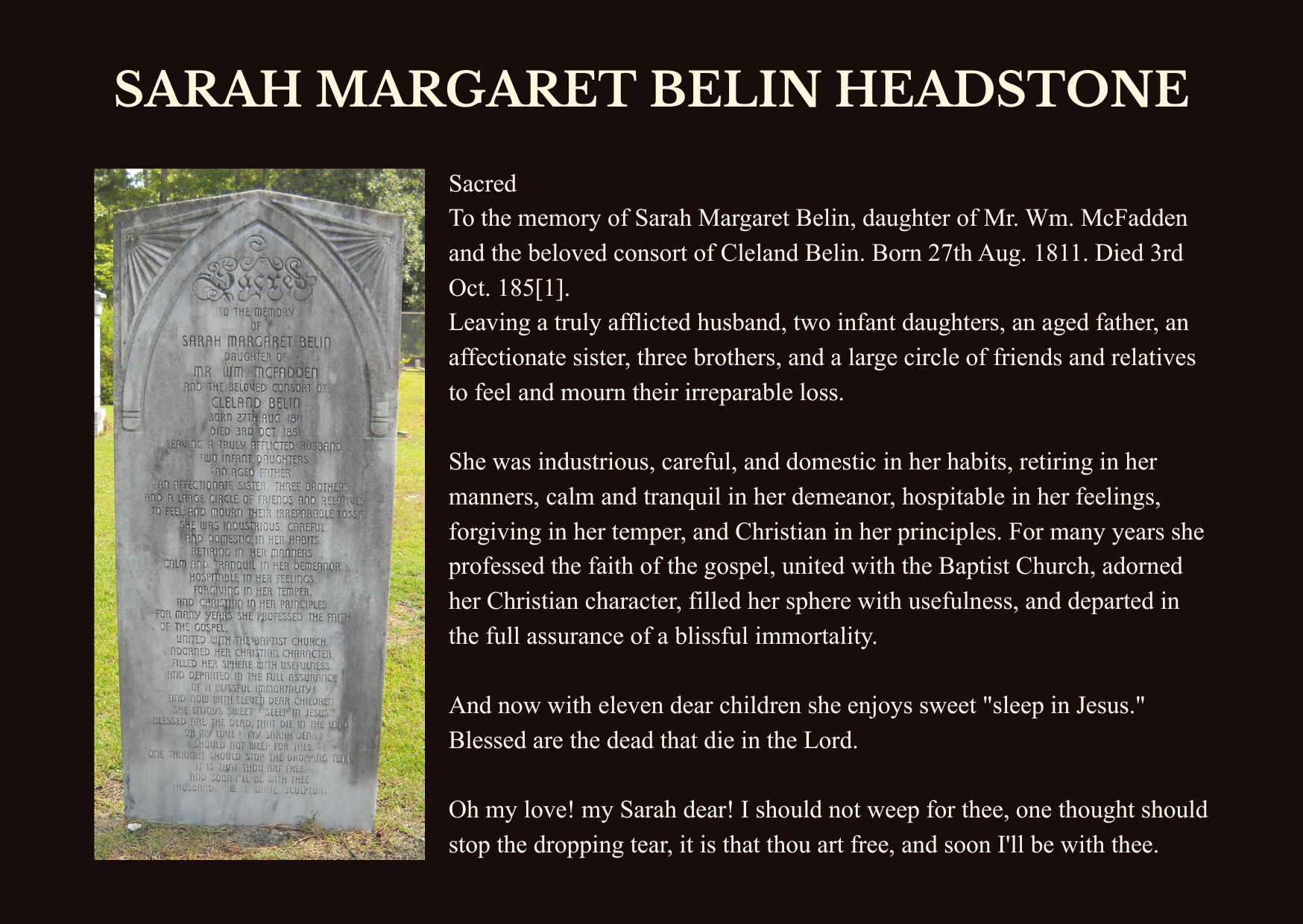
Source Note: Merchant career and flat-bottom boats documented in NRHP nomination and HABS, Library of Congress. Marriage and children confirmed in public records. Oral tradition regarding Screven lineage is not independently verified in primary records included here as community memory.
The Church He Built
In 1843, Cleland Belin built a church on his own land. He paid for it himself. The Black Mingo Baptist Church rose in the Greek Revival style, grand pillars, tall arched windows. From the outside, it looked like faith. It looked like permanence.


The church burned in 1992. What remains today are the brick pillars where it once stood, and the cemetery.
Source Note: Slave gallery confirmed in NRHP nomination. Second-story balcony and architectural details documented in HABS documentation. Enslaved labor in construction confirmed in historical records. Assault and battery charge referenced in oral tradition, not independently verified in primary court records, included here as community memory.
What His Will Said
Cleland Belin died on September 13, 1868. But before he did, he wrote something down that tells you exactly what kind of world he was trying to preserve.
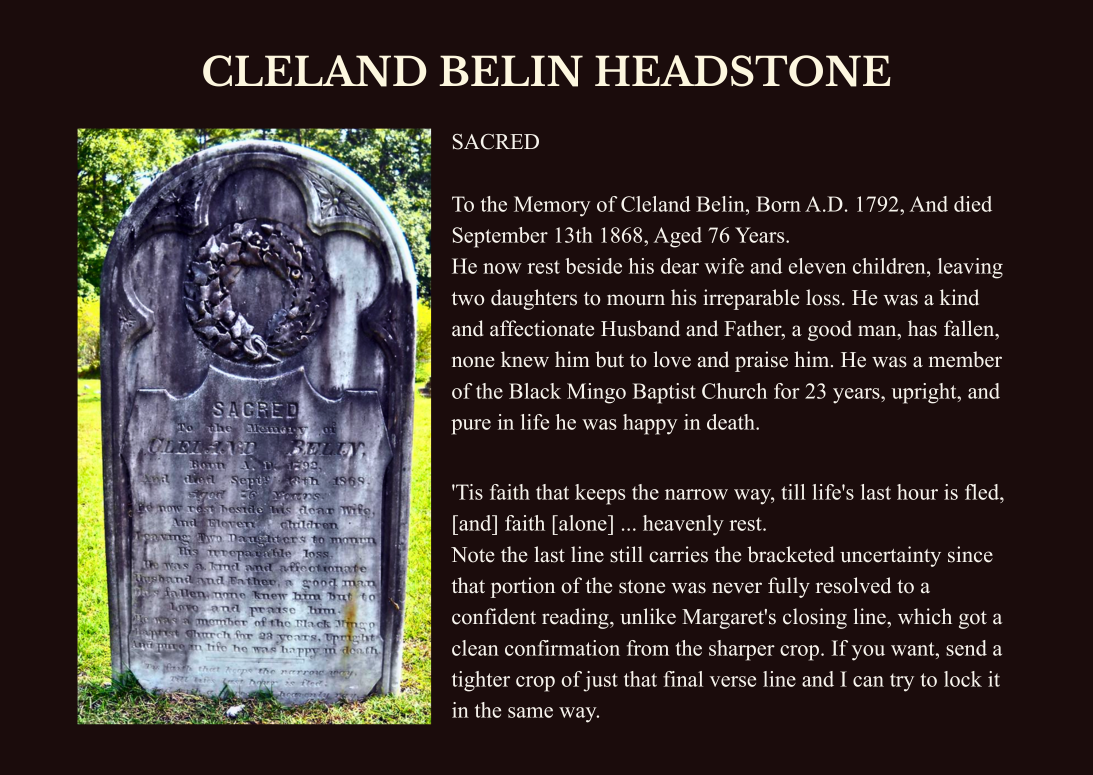
Source Note: Cleland Belin, Last Will and Testament, trustee elections and explicit exclusion of Black members confirmed as primary source. Death date September 13, 1868 confirmed in primary death records.
What the Cemetery Tells Us
The church building burned down in 1992. What remains today are brick pillars where it once stood, and the cemetery. And that is where the story gets most honest.
In that burial ground, the segregation did not stop at death. White families were buried in the main plots. Black members were placed in a separate section, behind a fence. Including a man named Bill.

"Sacred to the Memory of BILL. A Strictly honest and Faithful servant of CLELAND BELIN. Bill was often entrusted with the care of Produce and Merchandize to the value of many Thousand Dollars without loss or damage... an approved Member of the Black Mingo Baptist Church. Well done thou good and faithful Servant, enter thou into the joy of the Lord."
— Bill's headstone, Black Mingo Baptist Church cemetery (primary source)
Read that slowly. Belin's entire merchant network, the flat-bottom boats, the produce, the thousands of dollars moving up and down Black Mingo Creek, it ran on Bill. Bill's honesty. Bill's labor. Bill's knowledge of every single transaction.
And when Bill died, they put him behind a fence. Separated from the white congregation even in death. That headstone, carved in stone and paid for by someone, tells you two things at once: this man mattered deeply, and this society could not bring itself to say so equally, not even at the grave.
That tension is the whole story of Williamsburg County in one piece of rock.
Glossary
Flat-Bottom Boat
A shallow-draft vessel designed for creek and river transport. Belin used these boats to move tobacco, cotton, and agricultural produce along Black Mingo Creek to regional markets.
Greek Revival
An architectural style popular in the early 19th century American South, characterized by grand columns, symmetrical facades, and tall windows, used here to project permanence and civic authority.
Slave Gallery
A second-story balcony built inside Southern churches to physically separate enslaved Black members from white members of the same congregation during worship services.
Trustee
An elected official responsible for managing the property, finances, and governance of a church. Belin's will restricted this role exclusively to white members of the Black Mingo Baptist Church congregation.
Last Will and Testament
A legal document specifying how a person's property and wishes are to be carried out after death. Belin used his will to codify racial segregation in the governance of the church he built.
Segregated Burial Ground
A cemetery physically divided by race, with Black members buried in a separate, fenced-off section from white members, a practice that continued the social hierarchy of life into death.
Oral Tradition
Community memory passed down through generations by word rather than written record. Used in this chapter to preserve details about Belin's character and reputation that formal documents chose to omit.
Pious and Melancholy
A phrase used by community tradition to describe Belin's reputation, devoutly religious in public presentation, but carrying a personal heaviness, possibly shaped by the loss of eleven of his thirteen children.
Impertinence
A term used by slaveholders to label any act of human independence or questioning of authority by an enslaved person, reframing resistance as a punishable fault rather than a natural human response.