

Williamsburg County, South Carolina
James Zuill
The Scotsman Who Built Willtown on Paper
The Scotsman Who Built Willtown on Paper
James Zuill came from Scotland and arrived in Carolina with his wife, his instincts, and a clear understanding of how commerce worked. He planted himself at the intersection of the Black Mingo River and the overland trade routes, built a merchant network with the men around him, and made sure every decision he made was recorded on paper.
This chapter follows Zuill from Scotland to Willtown, from the counting house to his final will, and through the family alliances he built to make sure what he created would outlast him.
Chapter Contents
You may navigate this chapter via the index below.
I. March 20, 1810
A man is dying in Willtown. He knows it. So he picks up a pen.
II. The Will
Two executors. One wife. One trusted partner who would only later become family. The counting house came first, the family table came a generation after.
III. The Witnesses
One of the men in that room was Cleland Belin. His presence was not coincidence. It was evidence.
IV. Near His Friend
Five days after writing his will, Zuill died. His headstone recorded one last request the will never mentioned.
V. The Children and the Name
A grandson was named James Zuill McConnell. Two surnames. One inheritance. The alliance made permanent, a generation later.
VI. The Legacy
No battles. No public scandals. What Zuill left was something more durable, a paper trail that still speaks two hundred years later.
VII. Sources
Primary documents, family papers, and historical records that confirm everything in this chapter.
VIII. Glossary
Key terms and definitions to help place this chapter in its full historical context.
March 20, 1810
¹ Will of James Zuill of Willtown, S.C., dated March 20, 1810. Abstracted in The History of Williamsburg by Boddie, p. 225. ² Bailey family papers, in possession of Miss Maude Conway Bailey. As cited in The Beatys of Kingstree, p. 35.
Near His Friend
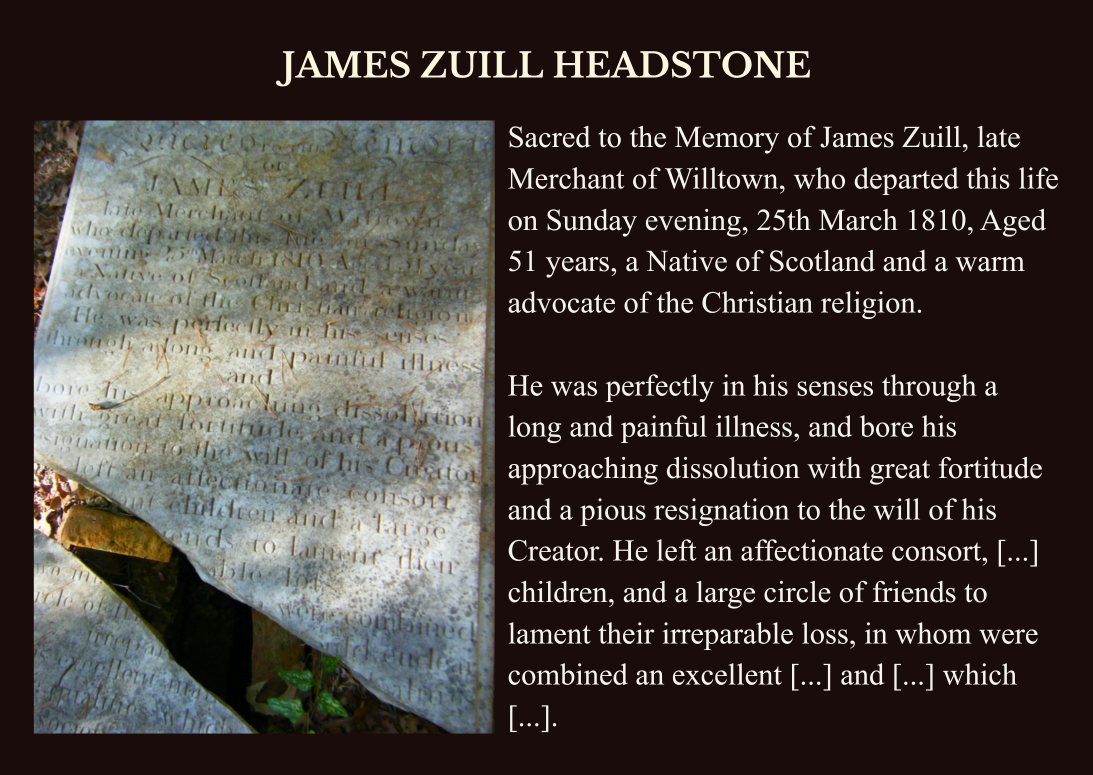
"Sacred to the memory of James Zuill, late Merchant of Willtown, who departed this life on Sunday evening 25th March 1810, aged 51 years, a native of Scotland and a warm advocate of the Christian religion... At his request he is laid near the remains of his friend John Mason, who died Anno Domini 1810."
James Zuill's headstone, transcribed on site
Source Note: Transcribed directly from a photograph of the headstone. Full inscription text cross-referenced against FindAGrave Memorial ID 55342712 (James Zuill, McConnell Cemetery, Nesmith, Williamsburg County, South Carolina). Burial location per FindAGrave; independent confirmation pending.
The Will
¹ Will of James Zuill of Willtown, S.C., dated March 20, 1810. Executors named: wife Margaret [Pressley] and Thomas "Old Tom" McConnell. Abstracted in The History of Williamsburg by Boddie, p. 225. Reproduced in The Beatys of Kingstree, pp. 34–36.
The Witnesses
¹ Will of James Zuill of Willtown, S.C., dated March 20, 1810. Witnesses confirmed: Cleland Belin, William Hitch, David Martin. Abstracted in The History of Williamsburg by Boddie, p. 225. Reproduced in The Beatys of Kingstree, pp. 34–36.
IV. The Children and the Name
My Two Little Children
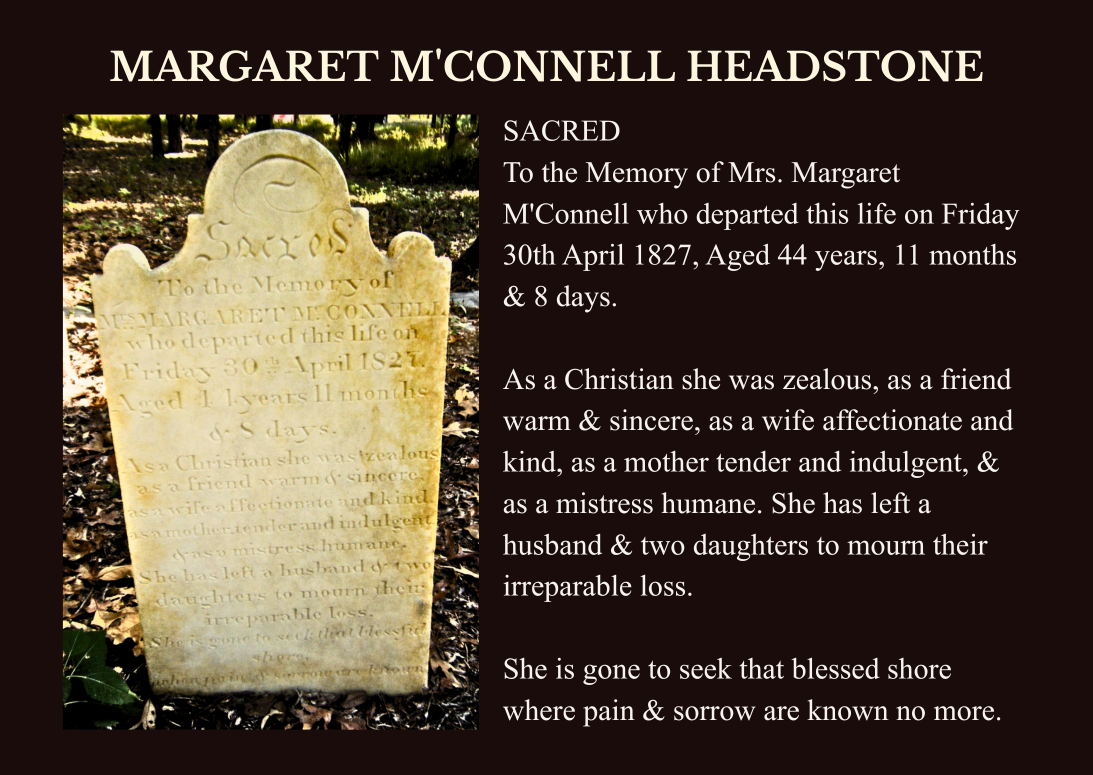
The will also named Zuill's children, referred to tenderly as "my two little children," John and Jane Pressley. Both names carry the signature of his Scottish roots, his wife's Pressley family name woven right into his children's.1
John, the younger of the two, died in childhood. He never married and left no descendants.
Everything Zuill built, therefore, passed to a single heir. Jane Pressley Zuill, his elder child, inherited the whole of her father's estate, Oak Hall Plantation included, because her brother did not live to claim his share.2
Jane grew up under the guardianship of her stepfather, Old Tom McConnell, the same man her father had trusted enough to name as executor. She married first, in 1827, Dr. John Jay Clarke, with Old Tom standing as her trustee. That marriage did not last into the next decade, and in 1832 Jane married again, this time to Old Tom's own son, who carried his father's name: Thomas McConnell. As his wife, she became Jane P. McConnell, the widow who would go on to run Oak Hall alone for decades (see her own chapter).
Two Surnames. One Inheritance.
Jane and her second husband's first son was given a name that said everything: James Zuill McConnell.3
A note on the name: this James Zuill McConnell is Jane's son, James Zuill's grandson through his daughter, not James Zuill's own son. John, James Zuill's son, died as a child and left no children of his own, he is a separate person from the grandson who later carried a version of his grandfather's name forward.
That son grew up to have children of his own, and the name Zuill kept traveling with them through the generations.
Think about that for a moment. Two surnames. One inheritance. A generation after Old Tom first stepped in as executor, his own son married the girl he had once been trusted to protect, a single, deliberate statement that the alliance between the Zuills and the McConnells was permanent. The name itself was the announcement.
1. Will of James Zuill of Willtown, S.C. Children referenced as "my two little children": John and Jane Pressley. Abstracted in The History of Williamsburg by Boddie, p. 225.
2. Tanya Jones, 20 years of primary genealogical research, Williamsburg County, South Carolina, confirms John died in childhood without issue, and that Jane, as sole surviving child, inherited the full estate.
3. James Zuill McConnell confirmed as the son of Jane P. Zuill and her second husband, Thomas McConnell, in The Beatys of Kingstree, pp. 34-35. Confirmed through the Bailey family papers. Marriage Settlement and Bond, John Jay Clarke and Jane P. Zuill, Williamsburg District, South Carolina, December 20, 1827; Oak Hall Plantation deed record, 1832.
The Legacy
James Zuill did not leave a dramatic story behind. No battles. No public scandals recorded in the sources we have.
What he left was something more durable: a paper trail that still speaks. The land. The business. The family. The name. Every decision documented, every alliance formalized, every connection put into writing so that it could not be undone by memory or time.
He put it in writing. The land. The business. The family. The name. Two hundred years later, we can still read every word.
That is not an accident. That is the whole point. Zuill understood that in a new country, on a new river, in a new town still finding its shape, the man who controlled the paper controlled the future. And he made absolutely sure the paper said exactly what he wanted it to say.
Sources
Glossary
Executor
A person named in a will to carry out the deceased's final instructions, managing the estate, settling debts, and distributing property. Zuill named his wife and Old Tom McConnell, a trusted business partner who would only later become family by marrying the widow Margaret.
Counting House
The office where a merchant kept financial records and managed trade logistics. For Zuill and Old Tom McConnell, the counting house came first, business built on trust between two men. The family table followed a generation later, when Old Tom's own son married into the Zuill line.
North Britain
A term used in the 18th and early 19th centuries to refer to Scotland, reflecting the political union of England and Scotland under one crown. Zuill's Scottish origin shaped his instincts for trade, documentation, and family alliance.
Black Mingo River
The waterway that ran through Willtown and connected the backcountry to coastal markets. Controlling access to this river meant controlling the flow of goods and commerce across Williamsburg County.
Regional Order
The informal but deliberate system of power built by merchant families through business partnerships, marriage alliances, and legal documents. It determined who owned what, who owed whom, and whose word carried weight in the district.
Paper Trail
The collection of legal and personal documents, wills, deeds, marriage records, and family papers, that Zuill left behind. Unlike handshakes or memory, these documents survived two hundred years and still tell his story today.
Stepfather
Old Tom McConnell became stepfather to Jane Zuill when he married her widowed mother, Margaret, sometime after 1810. He was not yet family when Zuill named him executor, that connection came afterward, and it made him her guardian and trustee, not her husband.
Family Alliance
A deliberate union between two families through marriage, designed to consolidate wealth, property, and influence. The name James Zuill McConnell was the public declaration that the Zuill and McConnell alliance, cemented when Old Tom's son married Jane, was permanent and intentional.
Witness
A person who signs a legal document to confirm its authenticity. The witnesses Zuill chose, Cleland Belin, William Hitch, and David Martin, were not strangers. Their presence reveals the tight inner circle of men who governed commerce and society in Willtown.